Wednesday, 2026/03/04

  • CS/AI
  • C
  • TITECH
  • Switch Language
    • ja日本語 (Japanese)
    • enEnglish

Shimosaka Research Group

pursuing MIUBIQ (machine intelligence in UbiComp Research)

  • Home
    • Members
    • Location
  • News
  • Projects
  • Publications
  • Awards
  • Archives
    • Codes
    • Datasets
Navigation
Projects Efficient Urban Dynamics Forecasting by Geometrically Complemented Multi-task Poisson Regression.

Efficient Urban Dynamics Forecasting by Geometrically Complemented Multi-task Poisson Regression.

2026/03/04 | Projects | 6 views |

Forecasting urban dynamics—i.e., the spatial and temporal distribution of active populations in a city—is an important problem for applications such as store planning, congestion forecasting, and crowd management. Although many studies have addressed urban dynamics forecasting, providing early forecasts (e.g., one week in advance) for an entire urban area remains challenging [Fan et al., UbiComp 2015; Jiang et al., AAAI 2018; Jiang et al., KDD 2019].

In this project, we aim to enable early and accurate forecasting of urban dynamics at a city scale, which we refer to as efficient urban dynamics forecasting. To achieve early prediction, we focus on large-scale schedule information generated by users, such as transit route search logs from navigation applications [Konishi et al., UbiComp 2016; Anno et al., SIGSPATIAL 2020].

However, two major challenges arise when using such data for early forecasting. First, although transit search logs reveal which stations people are likely to arrive at, they do not indicate the final destinations after users leave the stations. Second, urban environments around event venues are often complex: multiple venues and stations exist in close proximity, and abnormal crowding events may occur due to complicated inflow patterns from surrounding stations.

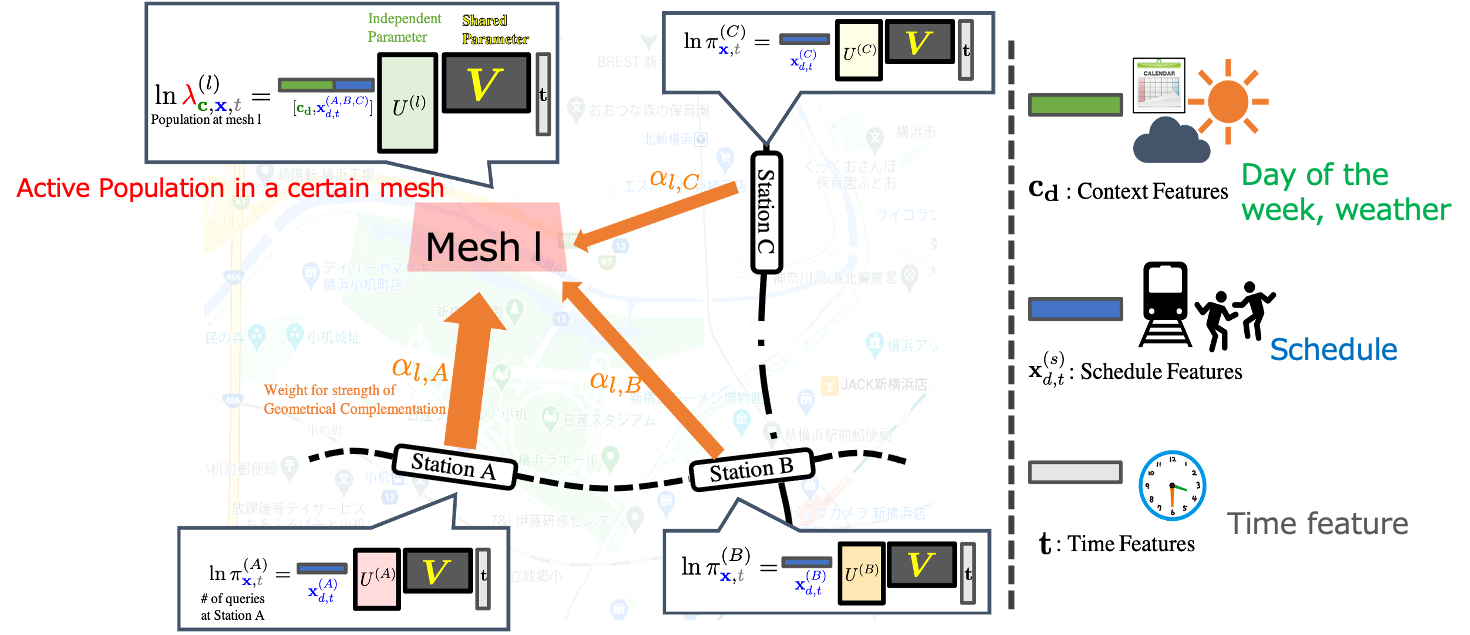
To address these challenges, we proposed Geometrically Complemented Multi-task Poisson Regression (GCPR). The proposed model jointly learns crowd dynamics in a target region together with user flow patterns from surrounding stations. By sharing parameters between these related prediction tasks, the model can compensate for the missing information about final destinations after station arrival.

Furthermore, to capture the spatial structure of urban environments, the degree of parameter sharing is adaptively determined based on both the geographical distance between stations and regions and the correlation of their population dynamics. This design enables the model to incorporate geometric relationships among stations and venues while accounting for differences between regions.

We evaluated the proposed method using GPS-based mobility logs and transit search logs collected for twelve large-scale events held across Japan between 2019 and 2020. The results show that the proposed model can forecast crowding not only around stations but also at venues located away from stations up to one week in advance. Compared with existing approaches, the method achieved up to a 42% reduction in prediction error.

Publications

Soto Anno, Kota Tsubouchi, Masamichi Shimosaka
Early crowd forecasting away from stations by geographically complemented regression using transit search and mobility logs
Journal of Big Data, 7 2025.

  • tweet

Comments are disabled for this post

Social Networks

  • twitter
  • rss

Recent News

  • Efficient Urban Dynamics Forecasting by Geometrically Complemented Multi-task Poisson Regression. 2026/03/04
  • Omni-CityMood: Vision-based Urban Atmosphere Perception from Every Angle at SIGSPATIAL2025 2025/11/04
  • Presenting our paper on Continuous Inverse Reinforcement Learning with State-wise Safety Constraints for Stable Driving Behavior Prediction at ITSC2025 2025/10/30
  • Presenting our paper on Exploiting Periodic UWB CIRs for Robust Activity Recognition with Attention-aware Multi-level Wavelet at PerCom2025 2025/02/15
  • Presenting our paper on revealing Universities’ Atmosphere from Visitor Interests has been presented at IEEE BigData 2024 2024/12/16
  • Our paper on adaptive incremental-decremental BLE placement optimization for accurate indoor positioning has been presented at IPIN2024. 2024/10/23
  • Presenting two papers at SIGSPATIAL 2024 2024/10/23
  • Forecasting Crowded Events using Public Announcements with Large Language Models 2024/10/15
  • Forecasting Lifespan of Crowded Events Inspired by Acoustic Synthesis Technique 2024/07/04
  • Our paper on forecasting lifespan of crowded events has been published in IEEE Access 2024/07/04

Search

Copyright 2015 · Shimosaka Research Group at TITECH